
Tuesday, August 2, 2011
Designing Ways: Ornamenting Grids: The Zentangle Dance
 8:19 AM |
  Posted by
Ellen Anne Eddy |
Posted by
Ellen Anne Eddy |


"A good artist should be able to draw with a berry on a fence." Tim Powers, Reach for the Sky
 Like everyone else, I'm in love with the whole Zen Tangle thing. I tend to find these things later than everyone else. I finally lift my head up and see what's been going on for a long long time.
But I've always been a full believer in more is more. I'm in love.
 What I've enjoyed most about this is the division and ornamentation of space. I also love the whole low tech part of it. These are done with a ball point pen on notebook paper.
 All of this started with a simple grid. We quilters tend to thing in terms of squares and rectangles, but really there are no rules.


But I've always been a full believer in more is more. I'm in love.

 All of this started with a simple grid. We quilters tend to thing in terms of squares and rectangles, but really there are no rules.
Here are a series of different grid fills. Left to right, we've filled in with spirals, a wonky ninepatch, a spider web, scallops, and a larger spiral. How fun is that?
How does that translate to quilting? We're still filling in space. Only with thread.Can you say "stipple?"
You'll find some very cool books on Zen Tangling on Amazon. See if it doesn't expand your thinking about space, design and the filling of space.
You'll find more of Sandi Steen Bartholomew's work at http://beezinthebelfry.blogspot.com/
 Labels:

Wednesday, July 6, 2011
Designing Ways: The Container and the Contained
" Mother, Mother, May I swim? Yes my darling daughter. Hang your clothes on the highest pin and don't go in the water."

In the same way we read mystery and horror novels, and watch romantic comedy, we flirt with edges. Come hither, hold on tight, don't let go, what really is at the edge? There's a lot of drama to be gained from art in the process of making a box and then breaking out of it.
We need the box. We need the safety and the security of it all. But we crave the excitement and drama of the edge. Where one thing starts and something else ends. When that edge is clean, straight and clear, it's very tidy. But it leaves us wanting to break out.
 Nature, life, the world, the universe is not full of a lot of straight edges. We impose those on our world, but they impose right back at us. A good example is mint in your garden. You may have planted it in a small plot in a straight line. Blink twice after a good rain and you'll find it across the yard and down the hill has well. My feeling is that I might as well just go along with it.
 So within art it's worth building both. You build the surface of your work, which is a container. Then you break out of that container,as nature itself is bound to do. The stripes here create a sense of order as well as filtered sun, but the leaf refuses to stay in place. It pops out and our ladybug comes right along with it.
 The vine here creates the border here, and our lady bug nestles within it. But it too refuses to stay just on the surface. It pokes out just enough that we know it's a living thing and not about to follow a ruler.
 This bug is contained by the flower she's on. But not entirely. She's clearly heading for the edge.
 Finally this bug and leaf create the border together. They are the container and the contained all in one.
Wrapping it up:
As quilters we're used to square corners and straight edges. We depend on them. They make a container for our images. But as we make borders and let our work edge right off them, we can take our contained work and put it in motion, by breaking out of the border and refusing to be contained.

In the same way we read mystery and horror novels, and watch romantic comedy, we flirt with edges. Come hither, hold on tight, don't let go, what really is at the edge? There's a lot of drama to be gained from art in the process of making a box and then breaking out of it.
We need the box. We need the safety and the security of it all. But we crave the excitement and drama of the edge. Where one thing starts and something else ends. When that edge is clean, straight and clear, it's very tidy. But it leaves us wanting to break out.


Wrapping it up:
As quilters we're used to square corners and straight edges. We depend on them. They make a container for our images. But as we make borders and let our work edge right off them, we can take our contained work and put it in motion, by breaking out of the border and refusing to be contained.
Wednesday, June 29, 2011
Designing Ways: Dancing in the Grid

Back to fabric design. We've all watched Dancing with the Stars. Once we're done with that and Steve Goodman, how about Dancing with Butterflies? Remember the Arther Mury patterns on the floor? Basically they were just moving in squares.

Just as an exercise in design, I took a butterfly drawing, colored it and went dancing with it in squares.

As I was playing with the placement, it wasn't long before I recognized that it was just like playing with a triangle quilt design.

Angling the butterflies as triangles and making them different sizes turned them into instant quilt squares. Who knew? Designing fabric is really designing quilts.

I did this in Illustrator, partially because I'm trying to learn the program and it was as good an exercise as any. But it would be so much easier in something like Electric Quilt 7. I flipped them, shrunk them, turned them, and made them dance.

Then I added a curlicue.
Fabric design is rhythmic pattern across a surface. It dances as it repeats itself, in the same patterns or in patterns that reflect or flip the original shape.
Like all dancing, it's endless, built for improvisation, but always in place with it's on rhythms. Am I there yet? I don't think so. I need to practice with Arthur Murry, just a bit more.Want to dance?
Wrapping it up: Designing both quilts and fabric is about rhythmic patterns in and out of a grid.
Find more information about designing fabric on Spoonflower.
Find really cool design software at
Wednesday, June 8, 2011
Designing Ways: Gravity Meets Geometry

What makes a shape move? We acknowledged that graphically on paper, things move strictly in our head. After years of things falling down around us, we can look at shapes at certain angles and say, "Yep. That's falling." We observe that it should be moving, and our mind makes it do that.
So what makes a shape itself mobile(moving) or static(staying still)?


But when we put them in a line and change the size the movement is in place and active. The eye connects them into a shape with one side much longer than the other, making things move.

 How does this translate to quilts that never have a square in them? All shapes are geometric shapes we manipulate into organic shapes. But the shape of the quilt itself, is the strongest one. A quilt designed with an elongated outline is in motion from it's inception.
Wrapping it up:
Symmetrical object are stable. They do not move unless you put them at an angle or unless you use them to create a shape that is longer on one side than another.
Non-symmetrical shapes aways have the suggestion of movement built in to their form.
Wednesday, June 1, 2011
Designing Ways: Gravity and Motion, Movement in Design
We talk about designs moving. But in reality, unless you're dealing with a series of images, they can't. A two-dimensional image is stuck in one place forever. What moves is not the image. It's our imagination of what happens next to the image. We imagine the movements that must, in our experience happen after where the image is now.
 We have a life long experience of gravity. We know when things are going to fall. We also can see from that same life experience when something appears balanced and stable. Our life experience supplies the suggestion that something is moving. The picture itself stays stable.What is the defining element? The angle of the object.
Our tree moves here because she's off balance. Her yellow background is at an angle against hers and the feeling is that she's in extreme motion.


Our tree moves here because she's off balance. Her yellow background is at an angle against hers and the feeling is that she's in extreme motion.

Our tree here is reaching up at a slight angle. But she's not really moving because she's stable against her background.

This tree is completely rooted and solid where she is. Her angle is straight and vertical to the sides of the work. She's
not going anywhere.
- Summing it up, all movement in design is an illusion formed from our memory and experience of gravity.
- If we recreate the feeling of falling or motion in a design, the design will appear to move.
- All movement is created in the angles we apply to our designs.
Tuesday, May 31, 2011
Designing Ways: East Meets West

It's almost impossible to talk about our art without talking about the art that comes before us. Before we talk about design, it's worth saying that there are many different design aesthetics. It's not that a design is good or bad necessarily. It's designed to be part of the statement. The notions that fuel our art choices are a statement loud and clear past subject matter and past our technical handling of fabric and thread.
As quilters, a lot of us have backed into art by accident. We started with squares and one day found ourselves with an odd quilt that somehow was an art quilt. Maybe it had too much orange in it or you found yourself like me, embroidering frogs and bugs into the borders.There's a tender soft spot in most quilter's artistic persona. The part that said that you should have gone to art school or studied water color. So our first designs spring out of a personal view. Later, as we become more facile, we realize that the choices in design are a huge statement all their own.

My first artistic love was the impressionists. I grew up near Chicago, and there was a pilgrimage every year to the Art Institute. I strolled through the halls looking for paintings like old friends. Since they were my first real introduction to art, they felt bland to me. Safe. Something soft and soothing out of my childhood.You know it's become mainstream when you see it on a birthday cake. This astonishing cake is by Megpi, a pastry chef in Silver Lake. California. You can see her work if you follow the link to Flickr.
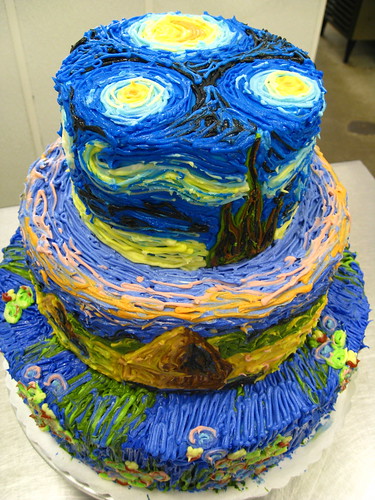
impressionist cake, a photo by megpi on Flickr
Since you can buy Van Gogh's work on umbrellas and coffee cups, it's easy to miss the point that he was a raving revolutionary in his time. His work nauseated the current critics, got him hospitalized, was refused for all the important salon shows, and the subject of ridicule in the press. Time and familiarity have made him a lionized artist, but that was not who he was when he began.

I was immediately in love when I discovered Japanese prints. It was a while before I realized why. The Impressionists took much of their new artistic vision from the prints out of Japan. The first prints that came out of Japan hugely influenced them as beginning artists.

In contrast, this is a painting called Nocturne from around 1825 by Turner. Turner would have represented the design aesthetics from the early 19th century, that Van Gogh and the other impressionists and Post Expressionists blew out of the water.
Early 19th Century Western art was about permanence. It honored stability. It was a world of people in their proper places, forever and ever. It used Greek and Roman scenes and portraits of nobility as an way of saying we had an eternal understanding of a world that stayed the same.
Japanese art was about the moment. It moved. It created a path for the eye to follow. It went off the page. The impressionists saw it, fell in love with the concept and incorporated it into the designing of their art. And changed us all.
The decisions behind design are the most telling. Without a word they say so much about what we create, what we find important, and what we value. The way we structure our art is at least half the story we tell.
Monday, May 30, 2011
Designing Ways: An Exploration of Design in Fiber Art
http://youtu.be/eNAcJ9o4XP0

Just recently I've been looking at the Spoonflower website. At Spoonflower you can design your own fabric.
That sounded simple. You add cool elements from your quilts on a neat background. How hard can it be? How cool can it get?
Well I don't think it get's cooler, but it's not as easy as it looks. I'm not ready for prime time yet but it's reminded me how important design is, and how it changes when we have different things we want out of our designs. So I'm going to take some time to explore design myself and to talk about that in some posts.
So often when we create we get all caught up in what we're creating. A flower, a frog, a bug, a picture. But design is the hidden framework under all of that. There are different aesthetics to design, different theories, different approaches. So when we talk about good design, we need to ask the question, "For what purpose."Designs that repeat are a whole different set of considerations from designs that don't have to. I'd like to look at design over a series of posts, from the point of view of pathway, rhythm, framing, and balance. Next time, East Meets West.
Subscribe to:
Posts (Atom)
Essential Embroidery Stitches

Get this free book from Quilting Arts. It has a series of articles I wrote called Defining the Line
My Blog List
-
Moving Day14 years ago
-
Getting Together14 years ago
-
Getting Together14 years ago


Facebook Badge

My Blog List
-
HARMONY2 weeks ago
-
Like a Rolling Stone2 months ago
-
Embroidered Felt Bowl #4.4 months ago
-
-
2021 Calendar5 years ago
-
A Change is Coming….6 years ago
-
GOrillas! on the Move!6 years ago
-
finish line in sight7 years ago
-
Easton Walled Garden7 years ago
-
-
Winsor Newton Pigment Marker Review9 years ago
-
gelliprint met gedicht9 years ago
-
Casey's T-shirt Quilt9 years ago
-
-
The San Salvador Sails By ...10 years ago
-
-
Construction Zone 10111 years ago
-
What a summer....so far12 years ago
-
Revealing BSBP 8....12 years ago
-
So this is Week 7?12 years ago
-
The last cloth doll making cruise13 years ago
-
-
Fall journey13 years ago
-
I've Moved...My blog That Is!13 years ago
-
This Blog has Moved....13 years ago
-
QUILTVERSE HAS BEEN REVIEWED!14 years ago
-
-
-


Guest Blog On Quilt Gallery
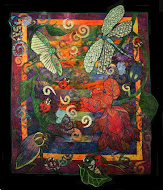
A Beauty Beheld
Guest Blog On Subversive Stitchers!
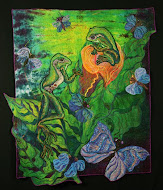
The Stories Tell Me
Networked Blogs


